
Understanding UBI
What is a universal basic income and why do we need it?
Why Do We Need Universal Basic Income?
After the Second World War, the growth of industry and technology powered amazing growth in the US economy, and ordinary wage earners shared that growth. This chart from the Shares in America book tells the story.
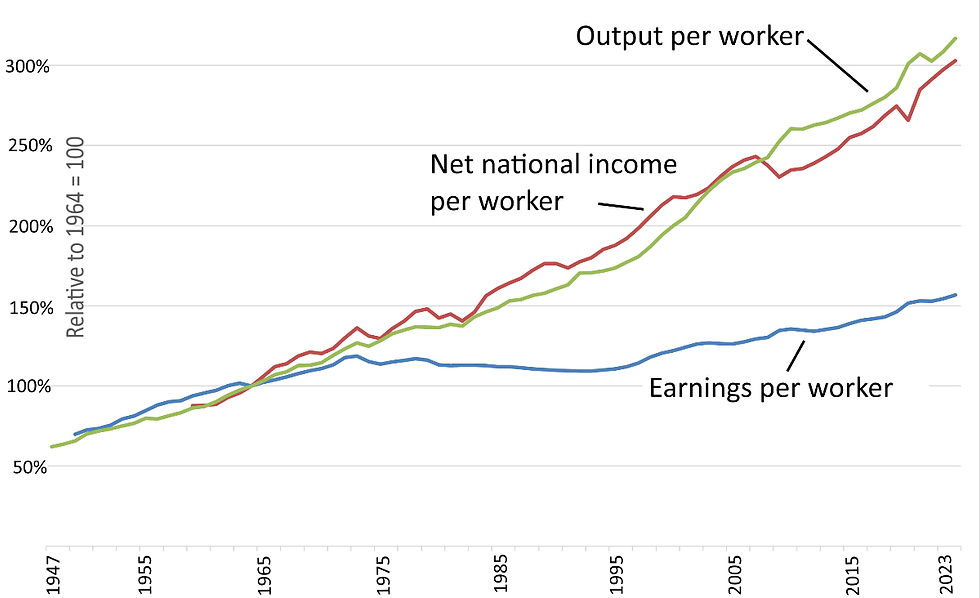
As you can see, before 1975, we all shared in the growth of the economy. After 1975 the economy kept right on growing but the increase in national income went almost entirely to the top of the income distribution while those at the bottom lost ground. The chart below shows share of national income by for the bottom 50% and top 10% of American households. Right now, half of American households share 10% of national income pretax!

The main reason for this change is automation, especially in agriculture and manufacturing. With the additional pressure on employment and wages from AI, this situation will only get worse.
Government transfers slightly improve the income distribution, but very inadequately and mostly through Medicare and Medicaid (Social Security is already included in the chart).
Can we fix this situation through more manufacturing jobs? As we show in the Shares in America book, the answer is no. Manufacturing is so highly automated that it doesn’t generate a lot of new jobs, and those jobs don’t pay very well. There simply isn’t a robust demand for general labor. People work, but many hardly make enough to get by. Gig and contingent work which are becoming widespread further testify to the insecurity of income. “Job” and “work” are no longer synonymous, and neither guaranty a decent living for many.
Our problem isn’t affordability, it’s that most jobs don’t pay enough.
US national income now comes to over $190,000 per household per year if it were distributed evenly, and it takes less and less work to produce a growing output. We’re a very rich country! But what is good news for the economy has turned out to be bad news for many. There is plenty to go around, but the concentration of income and wealth will only grow unless we do something.
The introduction to Shares asks: “How should the wealth of a rich, technologically advanced society be shared?”
It is in answer to this question that many economists, businesspeople, and many of the rich themselves have called for a universal basic income as the best way to make sure we all share somewhat in the country’s wealth.
Universal basic income is a dividend we all get for participating in our country’s amazing productivity. And unlike traditional welfare, it doesn’t discourage work, is market oriented, and doesn’t require a large bureaucracy to administer.