
Understanding UBI
What is a universal basic income and why do we need it?
What is a Universal Basic Income?
Universal basic income (UBI) is simple: everyone gets a monthly check, no strings attached. Think of it as Social Security—for everyone.
A common proposal is about $1,000 per month per adult, paid regardless of income. Work or don’t work, rich or poor—you still receive it.
The idea isn’t new. Versions of it go back centuries—from ancient Rome’s grain payments to a proposal by the colonial patriot Patrick Henry. Conservative economist Milton Friedman proposed a UBI (called a negative income tax back then) in 1962 and President Nixon tried to implement it in the 1970’s. It almost passed. Today, UBI is gaining attention again for a new reason: AI.
Automation has already replaced millions of jobs in agriculture and manufacturing. Now artificial intelligence is beginning to do the same in white-collar and service work. As machines do more, the demand for human labor falls—putting pressure on wages and widening inequality.
That’s exactly what we’ve seen in the U.S. since the 1970s: rising productivity, but paychecks that haven’t kept up. More and more income and wealth has flowed to the top.
Shares in America is a more descriptive name for universal basic income, and the name of my book on why we need it. In this site and the book, "Shares" refers to the Shares in America UBI program. which is defined on our home page.
Bottom line: a UBI means a guaranteed monthly income—say $1,000 per adult—paid to everyone, regardless of what you earn elsewhere.
Why Do We Need Universal Basic Income?
After the Second World War, the growth of industry and technology powered amazing growth in the US economy, and ordinary wage earners shared that growth. This chart from Shares in America tells the story.
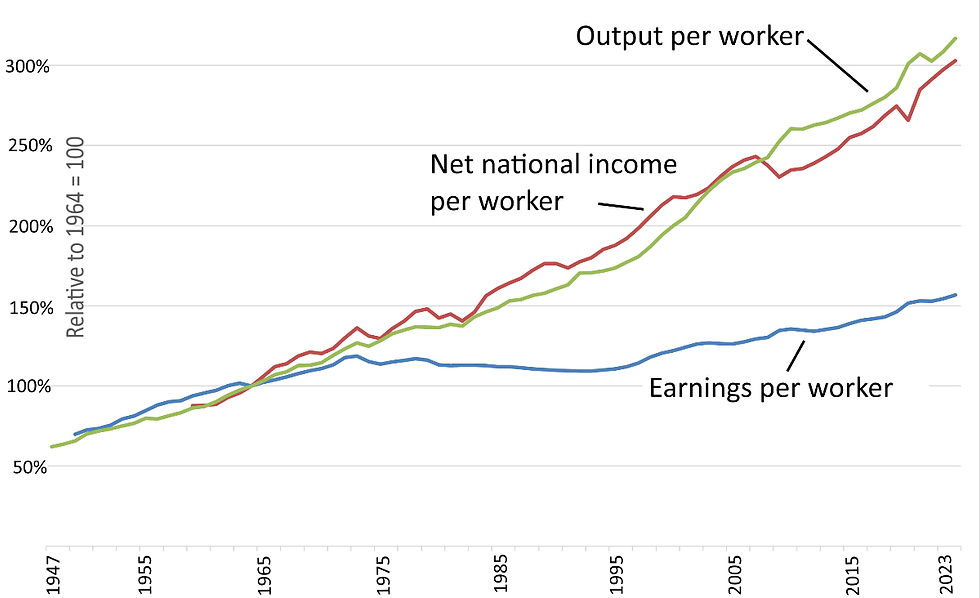
As you can see, before 1975, we all shared in the growth of the economy. After 1975 the economy kept right on growing but the increase in national income went almost entirely to the top of the income distribution while those at the bottom lost ground. The chart below shows share of national income by for the bottom 50% and top 10% of American households. Right now, half of American households share 10% of national income pretax!

The main reason for this change was automation, especially in manufacturing. With the additional pressure on employment and wages from AI, this situation will only get worse.
Government transfers slightly improve the income distribution, but very inadequately and mostly through Medicare and Medicaid (Social Security is already included in the chart).
Can we fix this situation through more manufacturing jobs? As we show in Shares in America, the answer is no. Manufacturing is so highly automated that it doesn’t generate a lot of new jobs. There simply isn’t a robust demand for general labor. People work, but many hardly make enough to get by.
Our problem isn’t affordability, it’s that most jobs don’t pay enough.
US national income now comes to over $190,000 per household per year if it were distributed evenly, and it takes less and less work to produce a growing output. We’re a very rich country! But what is good news for the economy has turned out to be bad news for many. There is plenty to go around, but the concentration of income and wealth will only grow unless we do something.
As I say in the introduction to Shares: “How should the wealth of a rich, technologically advanced society be shared?”
It is in answer to this question that many economists, businesspeople, and many of the rich themselves have called for a universal basic income as the best way to make sure we all share somewhat in the country’s wealth.
Universal basic income is a dividend we all get for participating in our country’s amazing productivity. And unlike traditional welfare, it doesn’t discourage work, is market oriented, and doesn’t require a large bureaucracy to administer.