UBI and Money in Politics
Updated: 2 days ago
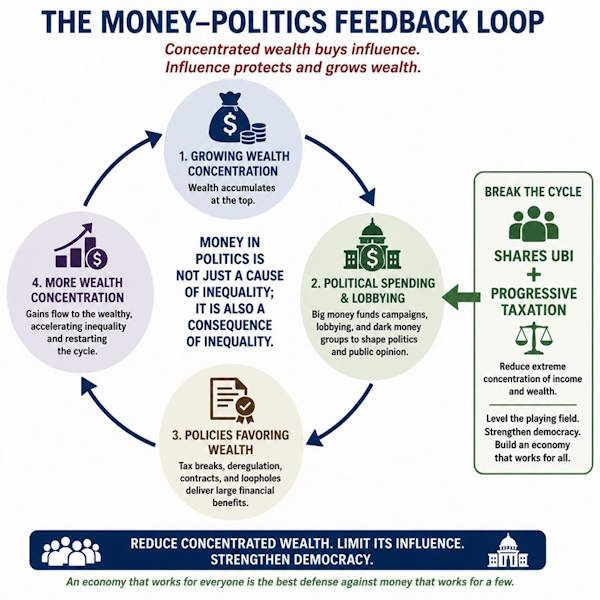
This post is a bit of a departure. I’m going to take a short look at money in politics in the US, what we can do about it, and how universal basic income fits in.
Our politics are money-soaked, and that goes for both parties. As I point out in Shares in America, the better-financed candidate in US House races now wins over 90% of the time, and 70% to 88% of the time in Senate races. Candidates and parties are beholden to those who finance their campaigns. In 2024 megadonors giving over $5 million each provided more than 75% of the funding to super PACs supporting major presidential candidates. And it’s not just federal campaigns. “Outside” money can be even more influential in local and state elections. What to the rich are relatively small amounts of money can completely dominate local elections. Unbelievably, only 18% of the money spent in US Congressional House races comes from within the Congressional district now, meaning over 80% comes from outside the district. Twenty-five years ago, most of these funds came from within the district.
Politicians must keep their wealthy and big corporate donors happy if they are going to win. That means that powerful monied special interests almost always get their way, whether it’s tax cuts for the wealthy or the oil industry’s successful efforts to block a transition away from fossil fuels. Of course, in addition to directly and indirectly influencing political outcomes, such interests engage in extensive public relations campaigns to mold public opinion. The federal government itself has been one of their prime targets since the mid-1970s.
People understand the inherent corruption of money in politics. Politicians don’t have to take traditional bribes to influence their positions; they are well aware of who finances their campaigns and even more crucially aware that special interests can spend unlimited amounts of dark money to help defeat or elect them “separately” from their campaigns.
Most Americans support limiting money in politics. A 2023 Pew study found that 72% of US adults believe there should be limits on the amount of money individuals and organizations can spend on political campaigns. This view is held by comparable majorities in both the Democratic (76%) and Republican (71%) parties. But thanks to the Supreme Court ruling that limiting money in politics is an infringement of free speech, such limits cannot be enacted without a Constitutional amendment or a different Supreme Court. We’re not likely to get either in the foreseeable future.
I asked ChatGPT, “What proposals are there to limit money in politics, how easy are they to achieve, and how effective are they likely to be?” The answer was, as usual, analytical and interesting. You can read it here. Measures to directly limit campaign spending will require a constitutional amendment or a different Supreme Court, so the most “implementable” measures that can level the electoral playing field include public campaign financing, “Democracy vouchers,” which allow ordinary citizens to support campaigns, and of course tax increases on high incomes combined with increased disposable income for those lower down the income scale to somewhat level the playing field. Universal basic income in other words.
As ChatGPT put it: “If one person has $50 billion and another has $50,000, the wealthy person will inevitably have greater political influence.” As I point out in Shares, a powerful feedback loop has developed over the last several decades: wealthy individuals and corporations invest in politics, reap substantial financial gains from favorable policies, and then reinvest a portion of those gains into even greater political influence.
Rebalancing income and wealth would not only restore a fairer distribution of economic gains; it would also reduce the resources available for concentrated political spending. Many campaign-finance reformers focus on how money enters politics, while Shares focuses on why money becomes politically dominant in the first place: the growing concentration of income and wealth. Reducing inequality through progressive taxation and Shares UBI may ultimately be as important as campaign-finance reform itself. Money in politics is not just a cause of inequality; it is also a consequence of inequality.
I would add another important effect of Shares UBI: it would strengthen the labor movement. Between 1998 and 2025, businesses spent $70.8 billion on lobbying, while labor spent just $1.2 billion. If individuals had at least $1,000 per month—and families at least $2,000 per month—to fall back on, workers would have more freedom to organize and strike. Employers would find strikebreaking more difficult because workers would be less financially vulnerable. Gig workers and other contingent workers would also be in a stronger position to organize.
Unions were one of the forces behind the great post–World War II equalization of incomes. Shares UBI would help them grow again in a post-industrial economy. Individual citizens rarely have the resources to create sustained political movements. Unions do.
In short, Shares UBI cannot solve the problem of money in politics by itself, but it can weaken one of its root causes: the growing concentration of income and wealth. When it comes to money in politics, we should concentrate on what we can get done with simple legislative majorities rather than pie-in-the-sky proposals such as overturning Citizens United or directly taxing wealth, both of which would likely require constitutional amendments.
Here’s the chart of proposals to address money in politics along with my summary assessment as to feasibility.
Comments